
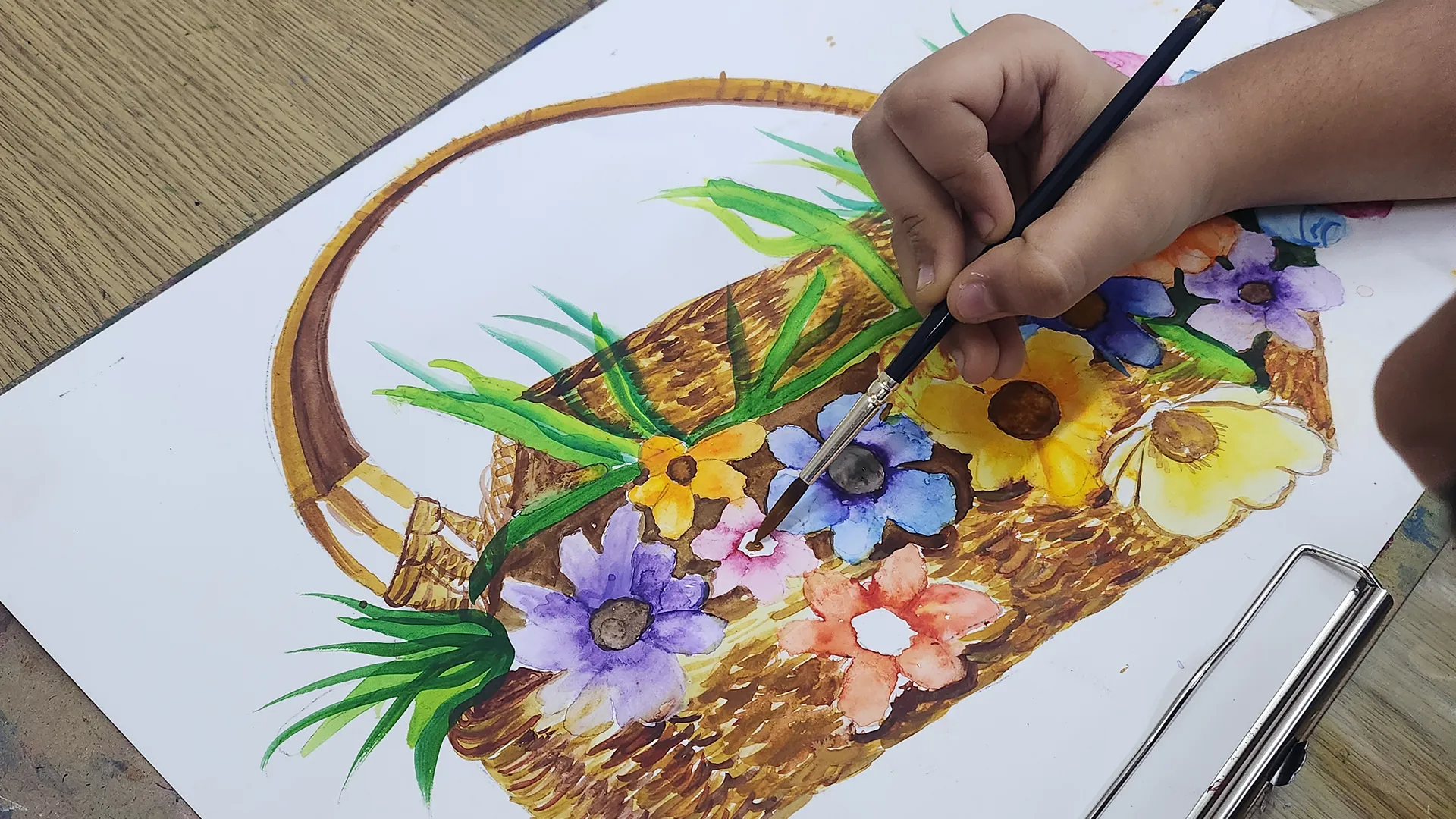
Many parents enrol their child in kids art classes expecting them to be painting detailed pictures within a few weeks. When progress looks slower than expected, or a child seems to be “just” drawing lines and shapes for weeks on end, it can feel like the class is not moving fast enough. In reality, this slower start is often exactly what a proper drawing foundation looks like.
Drawing, like any skill, builds in layers. Skipping the fundamentals to rush toward “impressive” finished pictures usually creates gaps that show up later, often in the form of frustration when a child struggles with proportion, shading, or composition without ever having built the basics underneath. This guide walks through what kids should actually learn first in drawing, step by step, so parents know what a proper foundation looks like and why it matters.
Step 1: Lines and Shapes
Before a child can draw a recognisable object, they need control over the most basic building blocks of drawing, straight lines, curved lines, and simple shapes like circles, squares, and triangles.
This stage focuses on:
- Pencil control, learning to draw steady, deliberate lines rather than shaky, uncertain ones
- Understanding that complex objects are made of simple shapes, a concept that becomes essential later when breaking down how to draw anything from animals to people
- Basic hand strength and grip, especially important for younger children still developing fine motor coordination
This stage might look simple, even repetitive, but it is doing important groundwork. A child with confident line and shape control finds every later stage significantly easier.
Step 2: Basic Shapes into Simple Objects
Once a child is comfortable with individual shapes, the next step is combining them into recognisable objects, a house from a square and triangle, a snowman from stacked circles, a simple car from rectangles and circles.
This teaches:
- How to break down real objects into simpler underlying forms
- Basic spatial planning, deciding where each shape goes relative to the others
- Early composition thinking, even if it is just deciding where on the page to place a drawing
This is often the stage where children start to feel genuinely excited, since they are now creating recognisable pictures rather than practising isolated lines.
Step 3: Proportion and Observation
This is where drawing fundamentals for children start to become noticeably more advanced. Proportion is the relationship in size between different parts of a drawing, and it is one of the most common areas where young artists struggle without proper guidance.
At this stage, children begin to:
- Compare sizes directly, such as noticing that a cat’s head is smaller relative to its body compared to a rabbit’s
- Draw from observation rather than pure memory or imagination, often starting with simple objects like fruit or toys
- Understand basic perspective concepts, like objects appearing smaller further away
Observation based drawing is particularly valuable here, since it trains the eye to actually look carefully rather than draw from assumption, which is a habit that benefits every stage that follows.
Step 4: Shading and Value
Once a child can draw reasonably accurate shapes and proportions, shading introduces the concept of light and form, which is what makes a flat drawing start to look three dimensional.
This stage covers:
- Basic shading techniques such as hatching, cross hatching, and blending
- Understanding light source and how it creates shadow and highlight
- Value control, meaning the range from light to dark, and how it is used to suggest depth
Shading is often where children start to see their drawings look noticeably more “real,” which tends to be a strong motivational turning point.
Step 5: Composition and Storytelling
With solid technical fundamentals in place, children can begin thinking about composition, how elements are arranged within a drawing to create balance, focus, and visual interest.
At this stage, children learn to:
- Decide what the main focal point of a drawing should be
- Understand basic composition principles, like avoiding placing everything directly in the centre
- Begin adding narrative elements, turning a simple drawing into a small visual story
This is also often where a child’s personal style starts to emerge, since composition choices reflect individual creative decisions rather than just technical accuracy.
Step 6: More Advanced Techniques
Once these fundamentals are genuinely solid, children are ready to explore more advanced areas such as:
- Working with different mediums, including charcoal, watercolour, or acrylic paint
- More complex subjects like detailed portraits or dynamic action poses
- Exploring personal artistic style and experimenting beyond structured exercises
Importantly, this stage works best as a genuine progression, not a shortcut. Children who rush here without solid fundamentals underneath often plateau earlier, since more advanced techniques rely heavily on the basics being second nature already.
Why Skipping Steps Often Backfires
It can be tempting, especially for older children or naturally talented young artists, to skip ahead toward more exciting, advanced looking work. However, gaps in fundamentals tend to surface later, often at more frustrating moments, such as struggling with proportion in a detailed portrait or losing control of shading in a larger painting.
A steady, structured progression through basic drawing skills may feel slower in the short term, but it consistently produces stronger, more confident young artists over time.
How Strokearts Builds This Foundation
At Strokearts, kids art classes follow a structured, age appropriate progression, starting with lines, shapes, and pencil control before gradually building toward proportion, observation, shading, and composition. Rather than rushing toward flashy finished pieces, instructors focus on making sure each foundational skill is genuinely understood before moving forward, which is what allows students to progress confidently into more advanced techniques and personal artistic style later on.
Frequently Asked Questions
What is the very first thing kids should learn in drawing?
Basic lines and shapes, along with pencil control, form the starting point. These simple building blocks make every later stage of drawing significantly easier to learn.
At what age should a child start learning proportion and shading?
This varies by child, but proportion is usually introduced once a child is comfortable combining basic shapes into simple objects, while shading typically follows once proportion understanding is reasonably steady.
Is it bad if my child is still practising basic shapes after a few weeks of classes?
No. Building confident line and shape control takes time and varies by child. A strong foundation at this stage usually leads to faster, more confident progress later on.
Why does my child’s drawing look “flat” even though the shapes look correct?
This is usually a sign that shading and value have not been introduced yet. Shading is what gives a drawing a sense of depth and three dimensional form.
Should my child skip straight to advanced techniques if they show natural talent?
It is generally not recommended. Even naturally talented young artists benefit from solid fundamentals, since gaps in basics often cause frustration later when attempting more advanced or detailed work.