
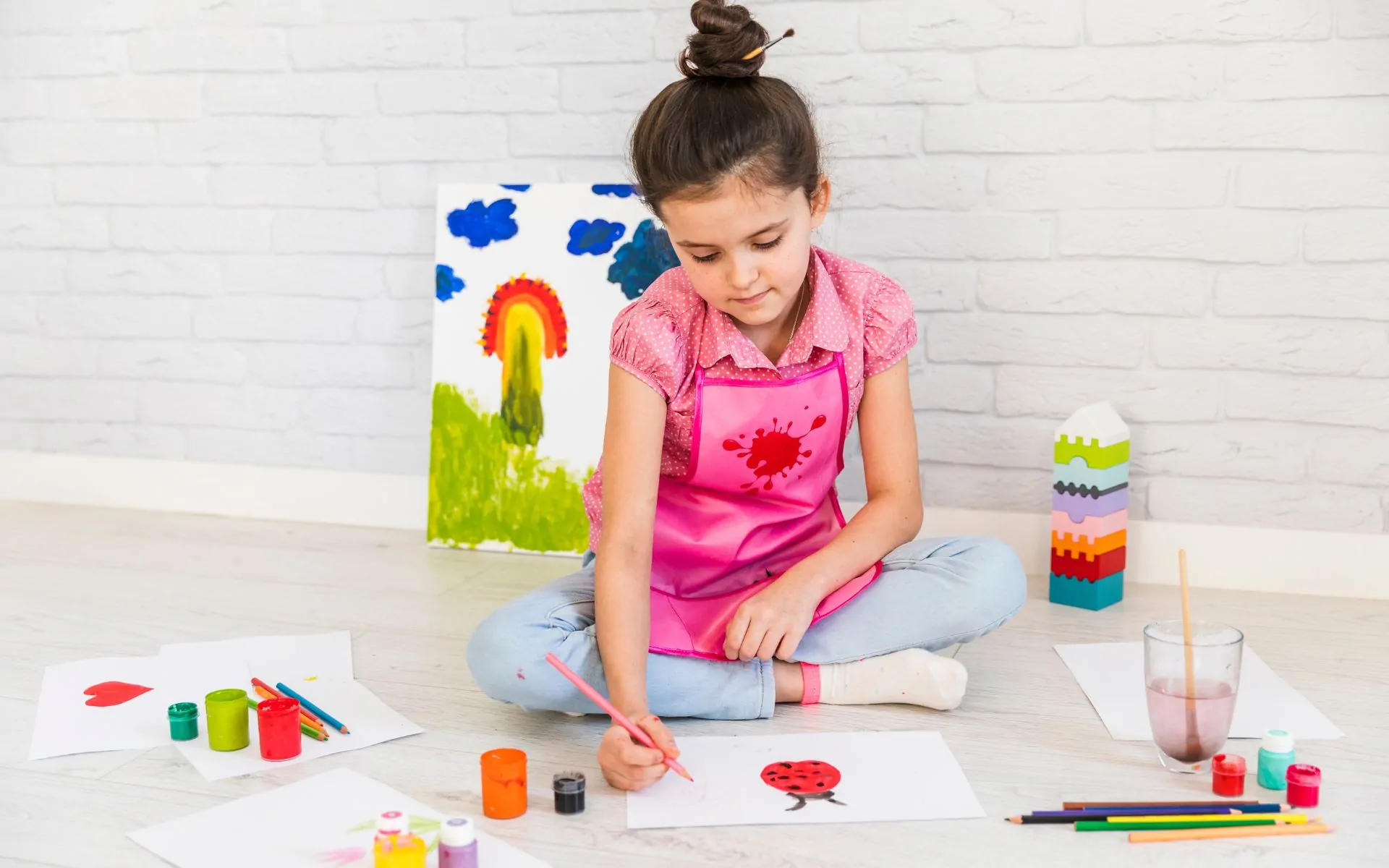
An essential aspect of childhood education is the development of the arts, which is sometimes disregarded in favor of more academic subjects like physics and arithmetic. On the other hand, a child’s mental, emotional, and cognitive development is positively impacted for a long time when their creative abilities are developed. Art encompasses more than just sketching and painting; it also requires expressiveness, problem-solving, and critical thinking—all crucial abilities for a child’s overall development.
This blog will help you understand the depth and benefits of encouraging children’s artistic growth and how doing so can improve their overall development.
Advantages of Supporting Artistic Development in Children
1. Enhancing Cognitive Skills
Art encourages children to explore and try new things by experimenting and developing their problem-solving abilities. With the help of artistic activities such as drawing, painting, or crafting, children learn how to think critically and come up with solutions. For example, if a child is given the task of building a sculpture from different materials, they must decide how to balance elements, choose the right textures, and figure out how to assemble the pieces in the correct form.
Engaging in art also improves visual-spatial skills, and activates children’s understanding of how objects fit properly, manipulate them, and visualize outcomes. These skills translate into everyday problem-solving power, boosting their cognitive abilities far beyond the art classroom. Nurturing creativity equips children with a unique toolkit for facing life’s challenges and enhances their overall intellectual capabilities.
2. Boosting Emotional Development
Art is one of the best methods for how children may communicate their feelings, among other things. Children can express emotions via art, whether it be through painting, drawing, or making, that they might not be able to articulate verbally yet. Through navigating emotions like happiness, sadness, rage, and exhilaration via artistic expression, they develop increased emotional intelligence and self-awareness.
Children who participate in artistic endeavors find their inner selves and learn methods for coping. This is especially helpful for kids who might have trouble expressing their feelings or communicating verbally. They use art as a medium to comprehend their feelings and learn healthy coping mechanisms.
Furthermore, allowing kids to create something original offers them a sense of success and boosts their confidence and self-esteem. Parents and educators may help children develop their artistic side while also supporting their emotional resilience, which is essential to their emotional development.
3. Encouraging Innovation and Creative Thinking
Creativity penetrates many facets of life and is not limited to creative pursuits. Children learn to think creatively when they are encouraged to display their artistic abilities. In the modern age, where originality and adaptability are highly prized in many sectors, the capacity to think creatively and innovatively is crucial.
Children are pushed to try new things, push limits, and discover new ways of doing things through artistic activities. Their capacity for innovation and creative thought is strengthened by this process, which benefits them in both social and academic contexts.
For example, a child must consider colour schemes, patterns, and ideas when making a unique work of art. They discover how to investigate options and take chances, which frequently results in discovering something novel. You can use this innovative attitude to solve problems in science, math, and interpersonal problems.
4. Building Fine Motor Skills
Children’s fine motor skills develop in parallel with their artistic development. Precision and control are needed for tasks like painting, drawing, cutting, and molding clay, which aid in the development of a child’s tiny hand and finger muscles. For daily chores like writing, buttoning garments, and tying shoelaces, these abilities are necessary.
Children improve their dexterity and hand-eye coordination by regular artistic exercise. Focus and accuracy are necessary for holding a paintbrush or cutting shapes, and these talents translate into better motor skills. Encouraging children’s creative development fosters their creativity and supports their physical growth.
5. Enhancing Communication Skills
Even though art is frequently thought of as a physical or visual medium, it is crucial for a child’s communication skills to develop. Youngsters can exchange ideas, express feelings, and tell stories through art. They get practice expressing their ideas, outlining their methods, and revealing the significance of their works when they converse with others about them.
Through the process of verbalization, they improve their communication skills and vocabulary, making them more proficient communicators. Talking about their work with adults or peers encourages youngsters to share their ideas and opinions in a more organized and logical way.
Furthermore, the development of the arts facilitates nonverbal communication. Children can express complicated concepts and feelings through symbols, colors, and forms, which improves their ability to communicate without using words alone.
6. Fostering Social Skills and Collaboration
Creating art is frequently a team effort, particularly in educational environments or cooperative endeavors. Collaborating on artistic endeavors teaches kids important social skills including compromise, sharing, and collaboration. They pick up skills like listening to others, working together, and contributing to a common objective.
Children are encouraged to interact with their peers through group art projects, which aid in the development of empathy and understanding. Their social relationships are improved when they learn to value many viewpoints and ideas. The basis for wholesome relationships and teamwork in later life is laid by these cooperative experiences.
Children who get creative development instruction acquire critical interpersonal skills that are essential for success in both their personal and professional lives.
7. Promoting Cultural Awareness and Understanding
Art is a language that speaks to people of all backgrounds and cultures. Children can learn about many countries, customs, and historical eras via artistic endeavors. Children’s exposure to a variety of artistic mediums broadens their perspective on the world and fosters an appreciation for cultural differences.
Children can, for instance, investigate many global art forms like Warli Art, Madhubani Folk Art, Kalamkari Art, Gond Art, Meenakari Art, Rajasthani Art, Pichwai Art and Lippan Art. Through exposure to Rangoli designs to many cultures, children learn to embrace diversity and become more inclusive and tolerant of others.
Encouraging children’s artistic growth makes them more culturally aware and globally minded people who are better equipped to manage a world that is getting more interconnected by the day.
8. Encouraging Lifelong Learning and Passion for the Arts
Fostering children’s imagination ignites a passion for the arts that lasts a lifetime. Youngsters who receive encouragement in their artistic growth are more likely to pursue their creative interests into adulthood. Whether they make art their profession or just a hobby, the creative attitude they were raised with influences both their personal and professional development.
Additionally, pursuing artistic endeavors fosters a passion for education. Children who are encouraged to explore the dynamic and ever-evolving area of art acquire a natural curiosity. Their natural interest can carry over into other subjects, increasing their motivation and level of engagement as learners for the rest of their lives.
9. Supporting Mental Health and Well-Being
Children are routinely exposed to stress, anxiety, and pressure in modern-era environments. Using art as a therapeutic outlet helps manage these difficulties. It has been demonstrated that being creative can lower stress levels and encourage relaxation. Children can express themselves via art without worrying about being judged or failing.
Fostering a child’s artistic growth gives them a way to express themselves and process their emotions, which benefits their mental health. Additionally, it promotes mindfulness since creating art demands concentration and focus, which helps kids gain composure and mental clarity.
Conclusion
Supporting artistic development in children is essential for nurturing their creativity, emotional intelligence, and cognitive skills. Through art, children learn how to think critically, express themselves, and collaborate with others. They develop fine motor skills, enhance their communication abilities, and gain a deeper understanding of the world around them. Nurturing creativity in children fosters innovation, emotional resilience, and a passion for lifelong learning, setting them up for success in all aspects of life. By prioritizing artistic development, we are investing in the future of well-rounded, creative, and confident individuals.
