
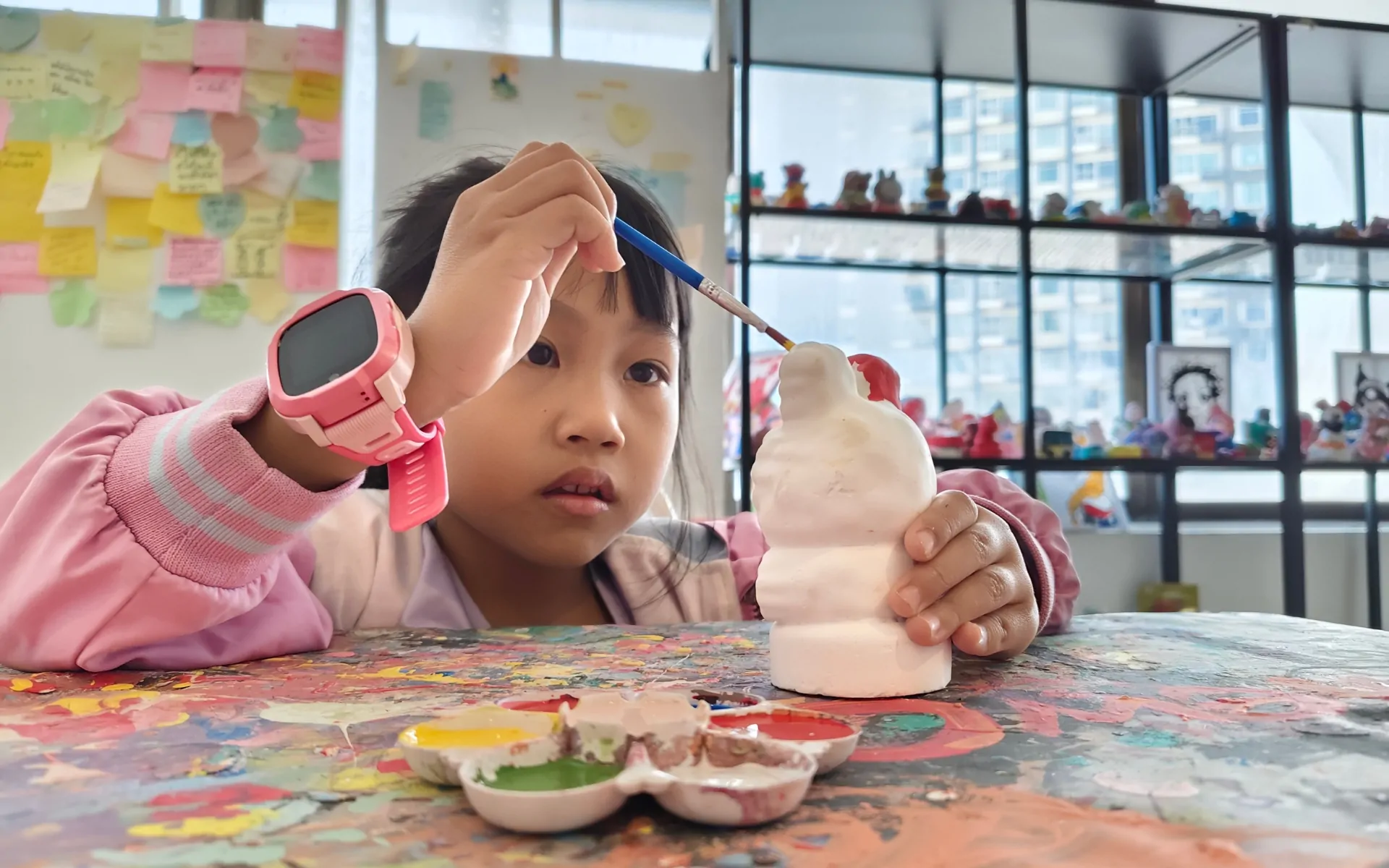
When parents think of art class, the first thing that comes to mind is simple. A child sitting with paper and pencils. Perhaps some paint. Perhaps some colour mixing. Something nice, something creative.
But when children are enrolled in structured art classes, the truth is that drawing is just the tip of the iceberg. The obvious end result is a drawing. But what’s really going on is something else entirely.
As time passes, parents will begin to realize that the learning is going far beyond lines and colours. The learning is happening in subtle ways, and it’s happening outside of the art class too.
1. Learning to See, Not Just Look
Children think they know what something looks like. A face, a tree, a cup. They can draw it from memory.
But in structured art classes, this kind of thinking is discouraged. Children are taught to really look. To notice proportions. To notice negative space. To understand that what they think they see and what they actually see are two different things.
This kind of thinking may seem small, but it has a profound impact on how children approach other tasks. They take their time. They notice details. They begin to understand that paying attention to details is the key to success.
This kind of attention to detail carries over into other areas of learning too.
2. Learning the Fundamentals Before the Fancy Stuff
Before children can learn to make complex works of art, there are some fundamentals that need to be covered.
In a good drawing class for children, teachers will spend time on line work, pressure, shapes, shading, and balance. Not because it’s repetitive and fun, but because fundamentals are important. They learn that skill takes time to develop. They practice controlling their movements. They learn about light and shadow. They learn that decoration follows structure.
These are the quiet foundations of visual literacy. Without them, confidence is tenuous. With them, children feel more solid.
3. Understanding Process Over Instant Gratification
Children today are accustomed to instant results. Tap, swipe, done. Art classes teach patience.
A project doesn’t begin with details. It begins with crude shapes. Then refinement. Then adjustment. Children are walked through this process again and again.
They begin to understand that excellent results take time. This is a lesson that applies well beyond the art room. It impacts how they approach school assignments, writing projects, even problem-solving.
Process becomes the norm rather than the source of frustration.
4. Building Fine Motor Strength and Control
Drawing is a physical activity. This is often overlooked.
Using tools properly, applying the right amount of pressure, making controlled lines. These take time to develop through practice and instruction.
Often, parents will see improvements in handwriting and dexterity after months of regular art instruction. This is no coincidence. The building blocks established through kids art fundamentals apply to development as well as creativity.
5. Learning to Reflect Rather Than Leaning on Praise
In a structured environment, children are not immediately told if their work is “good” or “bad.”
Rather, they are asked questions. What do you see? What feels balanced? What might you change next time?
This reflection promotes independence. Children learn to judge their own work in a calm manner. They become less reliant on approval. Confidence developed in this manner is less vocal, but more robust.
6. Becoming Comfortable With Mistakes
Mistakes are one of the most valuable lessons in art.
A line goes too far. A color mixes in an unexpected way. Rather than correcting right away, children are encouraged to adapt and move forward. This builds flexibility. It builds grit without using those loaded terms in the classroom.
Parents will see that children who once were paralyzed by small mistakes are now approaching problems with greater ease.
7. Growing Visual Confidence
Visual communication is a true skill. Children in well-designed children’s art classes learn about the power of layout. The power of color. The power of composition.
Over time, they become more confident at communicating their ideas visually. This helps with storytelling, with presentations, and with creative problem-solving. In a culture like Singapore’s, where communication skills are prized from an early age, visual confidence is an added strength.
8. Learning Discipline Without Feeling Pressured
Art classes are often thought of as being very relaxed and fluid. In fact, good art classes are very structured.
Children follow a routine. They prepare their materials. They clean up thoroughly. They work on a project over several class sessions.
The structure is there, but it doesn’t feel oppressive because it is connected to something fun. For many children, this is the first time they have ever experienced discipline as a natural part of their lives rather than something they are forced to do.
9. Seeing Their Own Progress Over Time
Skill does not emerge suddenly.
Children who attend structured classes start noticing improvement. Lines start to be more stable. Shading starts to be more controlled. Compositions start to look more deliberate.
When children notice their improvement, confidence develops organically. It is no longer about comparing themselves to others. It is about being better than they used to be. This mindset affects how they learn things in general.
10. Why Structure Makes the Difference
Drawing casually at home is important. It fosters creativity. However, it is not a substitute for structured development.
Structured children art classes provide a sense of progression. Lessons are linked. Skills are built cumulatively. Children are not pushed towards complexity too soon.
At Strokearts, the learning strategy is designed to focus on developing solid foundations first, allowing children to progress gradually in terms of skill and confidence.
What This Means for Parents
When children attend art classes, the benefits are not merely what is produced on the wall. They learn to observe. To practice. To reflect. To adjust when things do not go as planned.
These skills are not always immediately visible. However, over time, they affect how children respond to challenges in other areas of their life.This is what structured art education actually provides. It is not merely about drawing. It is something more profound that stays with them long after the lesson is over.